
- Novelty
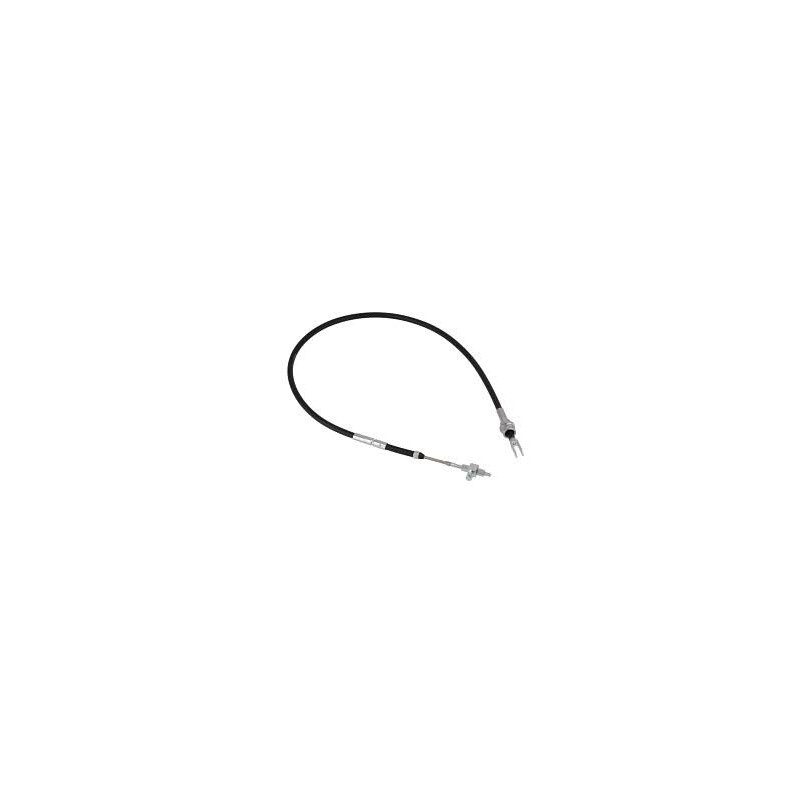

CABLE DE COMMANDE DE PRISE DE FORCE POUR NEW HOLLAND
Ref.: CAM199703
In stock,
- Free quotation
- French company

Product's description
Product's descriptionPower Take-Off Control Cable for New Holland TM Tractors – Part No. CAM199703
The CAM199703 PTO control cable is a replacement part designed for several New Holland TM Series farm tractors, from the TM125 to the TM190. It transmits motion between the control operated from the driver’s seat and the mechanism that controls the power take-off.
A worn, seized, loose, or broken cable can prevent the PTO from operating correctly. Replacing it restores smooth operation and prevents excessive force from being applied to the lever or the mechanical components to which it is connected.
This part is listed for different production periods depending on the model. Before placing an order, you must verify the tractor’s full model, date of manufacture, serial number, and the specifications of the removed cable.
Key Features
| Specification | Information |
|---|---|
| Designation | PTO Control Cable |
| Camagris Part Number | CAM199703 |
| Application Brand | New Holland |
| Compatible Series | TM |
| Main Models | TM125 to TM190 |
| Function | Mechanical power take-off drive |
| Part Type | Control cable for agricultural tractor |
| Condition | New replacement part |
The lengths, fittings, threads, fasteners, and adjustments must be compared with those of the original part.
Function of the PTO control cable
The cable connects the control located in the cab or near the driver’s seat to the tractor’s power take-off (PTO) mechanism. When the driver moves the lever, the motion is transmitted by a metal core that slides inside a sheath.
Depending on the tractor’s configuration, this movement may result in:
- engaging a control position;
- disengaging the mechanism;
- moving an external lever;
- selecting a PTO mode or speed;
- the actuation of a linkage;
- operating a device associated with the power take-off.
The exact function of the cable depends on the transmission version and the configuration installed on the tractor. Therefore, the same configuration as the original must be maintained.
Compatibility with New Holland TM Tractors
Cable CAM199703 is listed for the following New Holland tractors:
| New Holland Model | Specified Application Period |
|---|---|
| TM125 | November 1999 through August 2002 |
| TM130 | From June 2002 to September 2008 |
| TM135 | From November 1999 to August 2002 |
| TM140 | From June 2002 to December 2008 |
| TM150 | From November 1999 to August 2002 |
| TM155 | From June 2002 to October 2008 |
| TM165 | From November 1999 to September 2002 |
| TM175 | From June 2002 to April 2007 |
| TM190 | From June 2002 to May 2007 |
These time periods help identify the applications, but they do not replace a verification using the serial number and the original cable part number.
New Holland TM125
The CAM199703 control cable may be installed on the New Holland TM125 manufactured between November 1999 and August 2002.
The TM125 belongs to the first generation of this model line. Over the course of its production, various changes may have been made to the controls, mounts, or PTO equipment. It is therefore recommended that you compare the ends of the cable before ordering.
New Holland TM130
Listed as compatible with the New Holland TM130, from June 2002 to September 2008.
The TM130 was on the market for several years and may feature different equipment configurations. The cab type, transmission, and PTO configuration must be taken into account to confirm compatibility.
New Holland TM135
The cable is also intended for the New Holland TM135 manufactured between November 1999 and August 2002.
Before installation, check the cable’s travel, its routing through the tractor, and the shape of the fasteners. A cable that is nearly the correct length but not quite may prevent normal adjustment of the control.
New Holland TM140
The CAM199703 is listed for the New Holland TM140 manufactured from June 2002 to December 2008.
This long production period may include various installation variations. The serial number is therefore an important piece of information for determining compatibility.
New Holland TM150
This cable may be suitable for the New Holland TM150 manufactured from November 1999 to August 2002.
Replacement must be performed without altering the routing of the cable housing. The original routing helps avoid excessively tight bends, friction, and contact with hot or moving parts.
New Holland TM155
Compatibility confirmed for the New Holland TM155, manufactured from June 2002 through October 2008.
When removing the cable, it is recommended to precisely mark the positions of the clips, brackets, and adjustment points. This information will facilitate the installation of the new cable.
New Holland TM165
The CAM199703 cable can be installed on the New Holland TM165 manufactured between November 1999 and September 2002.
It is recommended to inspect the lever and linkage at the same time as the replacement. A seized pin or stiff joint can significantly increase the force applied to the cable.
New Holland TM175
Approved for use on the New Holland TM175, from June 2002 to April 2007.
The control should move freely once the cable is disconnected. If the mechanism remains difficult to move, the cause of the malfunction may be a lever, a joint, or an internal component—not the cable alone.
New Holland TM190
The PTO control cable is also listed for the New Holland TM190 manufactured between June 2002 and May 2007.
On this model, as on other tractors in the TM series, the specified adjustment must be followed to ensure sufficient travel without keeping the cable constantly under tension.
A component subject to repeated movement
The control cable is engaged every time the PTO mechanism is operated. Its metal core moves inside a sheath and transmits the force applied by the operator.
Over time, several issues may arise:
- wear on the metal core;
- deterioration of the sheath;
- moisture penetration;
- corrosion;
- increased internal friction;
- deformation of a fitting;
- play in the joints;
- loosening of an adjustment;
- damage to a clip;
- partial or complete cable breakage.
A deteriorated cable can gradually become stiffer before breaking. A control that feels unusually stiff should therefore be checked immediately.
Signs of a Worn PTO Cable
Replacement may be necessary if you notice:
- a PTO lever that is difficult to move;
- an abnormally stiff control;
- excessive lever travel;
- difficulty controlling the PTO;
- a position that does not engage properly;
- control does not return properly;
- cable with slack;
- cracked or crushed housing;
- cable frayed at one end;
- deformed end cap;
- damaged adjustment thread;
- broken bracket or clip;
- control has no effect;
- complete cable break.
A stiff shift does not automatically mean that the cable is defective. You should also check that the lever and the mechanism it operates move freely.
Common Causes of Wear
Cable wear can be accelerated by:
- an incorrect path;
- excessive curvature;
- contact with a hot part;
- friction against sheet metal or a support;
- a poorly secured duct;
- water or dust ingress;
- a seized power take-off mechanism;
- incorrect adjustment;
- excessive force applied to the lever;
- use of a part of the wrong length;
- missing fasteners;
- tractor vibrations;
- a sheath that was pinched during a previous repair.
If the worn cable broke due to a seized mechanism, installing a new part without fixing the underlying cause may result in another rapid breakage.
Difference Between a Broken Cable and a Seized Mechanism
Before replacing the part, it is helpful to disconnect the cable and check both components separately.
The control in the cab should move normally without any resistance. The lever or linkage on the PTO side should also move as intended.
This diagnostic process can help distinguish between:
- a cable seized in its sheath;
- an oxidized external joint;
- a deformed lever;
- a loose fastener;
- a stiff internal mechanism;
- insufficient travel;
- an adjustment issue;
- a malfunction unrelated to the cable.
Do not force the control. Excessive pressure can break the lever, the end cap, or the cable housing mount.
Checks Before Ordering
Before ordering cable CAM199703, note the following information:
- the exact model of the New Holland tractor;
- date of manufacture;
- serial number;
- part number printed on the old cable;
- total length;
- length of the sheath;
- effective length;
- shape of both ends;
- diameter and thread type of the adjustment mechanisms;
- number of attachment points;
- type of clips;
- cable location;
- precise function of the control;
- type of power take-off or transmission.
A difference of just a few centimeters in length or a differently shaped end can prevent installation or make adjustment impossible.
Importance of Length and Stroke
Total length is not the only factor to consider. The effective stroke of the inner core must also match the movement required by the control.
A cable that is too short may:
- remain constantly under tension;
- prevent the lever from returning fully;
- limit the mechanism’s travel;
- increase the stress on the cable ends;
- cause premature wear.
A cable that is too long or improperly adjusted can create excessive play and fail to move the control lever far enough.
Installation Tips
Before beginning work, park the tractor on a level surface, turn off the engine, and remove the key. The PTO must be turned off, and any attached implements must be secured.
General Procedure:
- Properly secure the tractor.
- Turn off the engine and remove the ignition key.
- Note the entire route of the old cable.
- Take a photo or mark the position of the settings.
- Disconnect the cable at the control end.
- Disconnect the other end at the mechanism.
- Remove the clips and brackets without damaging them.
- Compare the new cable with the removed part.
- Check the length, travel, and ends.
- Install the cable by following its original route exactly.
- Avoid sharp bends and pinch points.
- Reinstall all retaining clips.
- Connect the two ends.
- Perform the specified adjustment.
- Operate the control with the motor stopped.
- Check the entire stroke.
- Perform a cautious test run after reassembly.
- Check the adjustment again after the first few uses.
The cable must not be taut when at rest, and its sheath must remain properly secured in its supports.
Adjusting the Control Cable
Adjustment allows you to align the control’s position with the mechanism’s actual movement. It must allow for a full stroke without placing constant stress on the cable or lever.
Incorrect adjustment can cause:
- incomplete engagement;
- an undefined position;
- excessive play;
- stiff operation;
- accelerated wear on the end caps;
- constant tension on the cable;
- incorrect indication of the lever position.
The adjustment values must be found in the technical documentation corresponding to the tractor and its serial number.
Cable Routing
The cable route directly affects its flexibility and service life. The cable must follow the routing provided by New Holland.
Avoid:
- excessively tight bends;
- contact with the exhaust;
- immediate proximity to a hot surface;
- friction against a metal edge;
- being pinched under a hood or sheet metal;
- contact with a rotating shaft;
- areas exposed to cab movements;
- a cable sheath that is not properly secured.
Excessive kinking increases internal friction and makes the control harder to operate, even with a new cable.
Should a new cable be lubricated?
Whether a cable needs to be lubricated depends on its design. Some cables are lubricated during manufacturing and do not require additional lubricant. Others can be treated with a compatible lubricant as part of routine maintenance.
Do not automatically inject thick grease or harsh chemicals into the housing. An unsuitable lubricant can trap dust, corrode certain materials, or harden at low temperatures.
It is best to follow the manufacturer’s recommendations and, above all, keep the external joints clean and protected.
Inspection of Related Components
When replacing the cable, also check:
- the condition of the control lever;
- the hinge pins;
- the bushings;
- the return springs;
- the pins;
- the locking clips;
- sheath supports;
- adjustment threads;
- linkage;
- the actuated mechanism;
- heat shields.
A missing sheath clamp can absorb part of the cable’s movement and prevent the movement from being fully transmitted.
Precautions Regarding the Power Take-Off (PTO)
The power take-off transmits high mechanical power to agricultural implements. Any work must be performed with the engine shut off and the key removed.
Before any test run:
- make sure no one is near the shaft;
- check that all guards are in place;
- make sure the drive shaft is properly shielded;
- keep loose clothing away;
- never touch a rotating drive shaft;
- Perform initial tests at low RPM;
- Stop immediately if you hear any unusual noise.
Replacing the cable does not exempt you from checking the overall operation of the system and the tractor’s safety devices.
Preventive Maintenance
To extend the service life of the control:
- Regularly check that the lever moves smoothly;
- inspect the sheath;
- replace any missing clips;
- check for friction points;
- keep the joints clean;
- Check for signs of corrosion;
- avoid forcing a stuck control;
- Check the adjustment after servicing;
- protect the cable from heat sources;
- Check that the sheath is securely fastened.
A control that gradually becomes stiffer is often the first sign that a cable or mechanism needs attention.
New Holland PTO control cable available from Camagris
The CAM199703 cable allows you to repair the PTO control on many compatible New Holland TM125, TM130, TM135, TM140, TM150, TM155, TM165, TM175, and TM190 tractors.
Camagris offers new parts for the PTO, transmission, clutch, and mechanical controls of farm tractors. We ship our products quickly throughout France and all of Europe.
An error occurred
Your equipment is not listed? Contact our customer support
Customers who bought this product also bought:


Ref: SIEGMANI
Shipping within 24 hours



Ref: DEM 0669
Shipping within 24 hours

1-POLE MOM/OFF/MOM LEVER SWITCH
Ref: 601746
Shipping within 24 hours
KIT BEQUILLE HYDRAULIQUE POURE REMORQUE AGRICOLE - 617008
Ref: 617008
Shipping within 24 hours